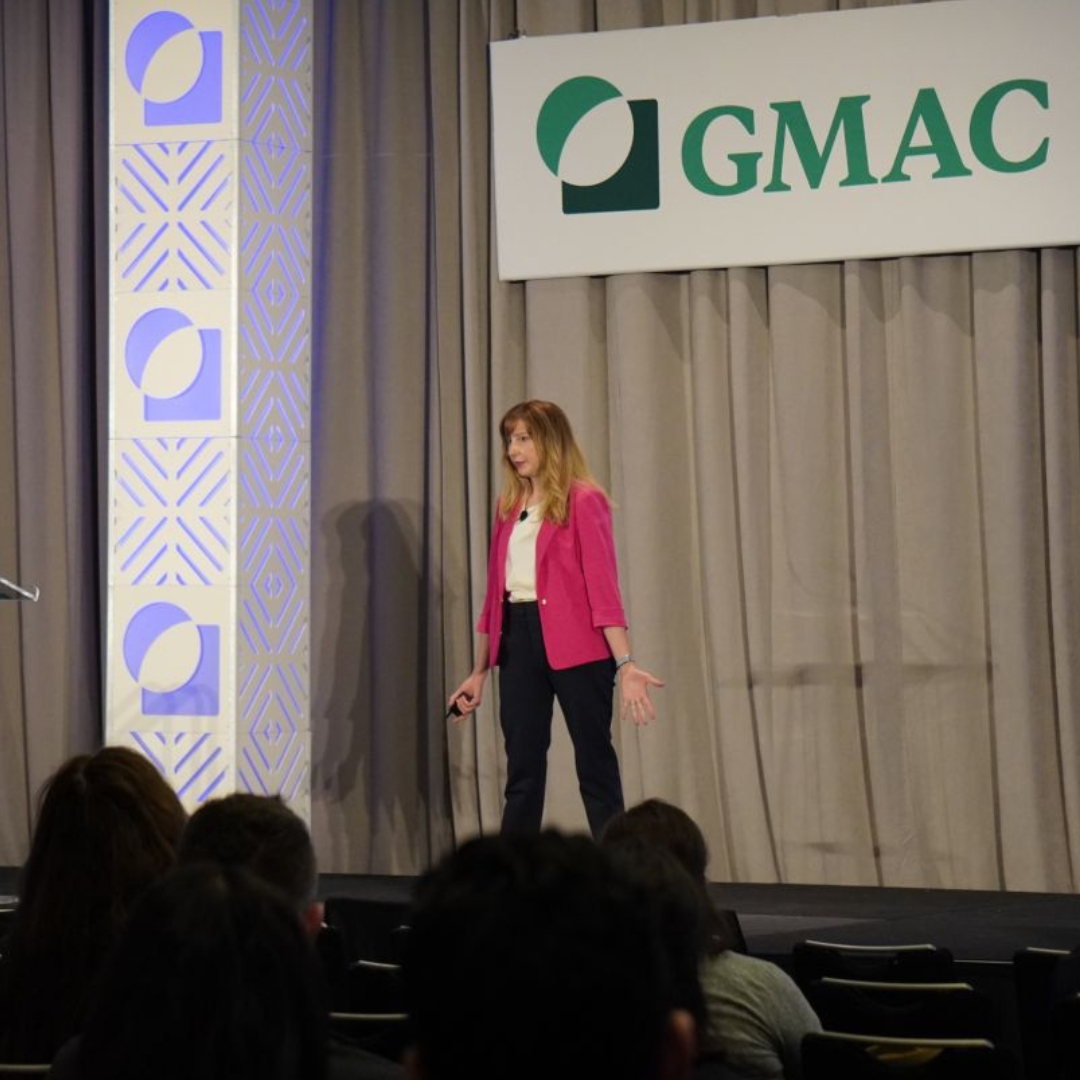
Higher education leaders today are navigating increasing complexity, evolving student expectations, and constant change. During the closing keynote at the 2026 Graduate Management Admission Council (GMAC) Annual Conference, Michelle Austin, managing director of the Sanger Leadership Center and adjunct lecturer at Michigan Ross, shared practical strategies to help leaders move from reacting to challenges to leading with intention.
In her presentation, Leading in the Tension: Insights and Tools to Take Back to Campus, Austin drew on the research-backed Michigan Model of Leadership (MMoL) to explore how leaders can thrive amid competing demands and build more adaptable teams. Here are a few of the key takeaways.
Three Shifts for Personal Leadership Growth
Shift from “Doing” to “Experimenting”
Leadership isn’t a fixed set of traits—it’s a series of intentional choices. Rather than striving to “get leadership right,” Austin encouraged leaders to treat growth as an ongoing experiment. Set a learning goal, try a new behavior, gather feedback, and adjust along the way.
Manage Tensions, Not Just Strengths
Leadership growth often happens outside our comfort zones. Instead of relying solely on our natural strengths, Austin challenged attendees to intentionally practice the leadership behaviors they use less often. Developing the ability to balance competing priorities—such as relationships and results or stability and innovation—builds the adaptability leaders need in complex environments.
Move Slow to Move Fast
The best time to prepare for uncertainty is before it arrives. By establishing clear decision-making frameworks, shared expectations, and team norms during calmer moments, leaders can respond more effectively when challenges arise.
Three Tools to Empower Your Team
Discover Your Team’s Strengths
Understanding how your team’s leadership strengths complement one another is the first step toward leading more intentionally. Austin encouraged attendees to begin with the free, 10-minute Michigan Model of Leadership assessment to better understand individual and collective leadership behaviors.
Make Leadership Growth Visible
Leadership development is more effective when it’s shared. Austin suggested creating a simple, shared space where team members can document the leadership behaviors they’re practicing, helping foster accountability, support, and continuous learning.
Depersonalize Conflict
Conflict is often a reflection of competing organizational priorities—not competing personalities. By using the Competing Values Framework to understand different perspectives, leaders can shift conversations away from personal differences and toward productive problem-solving.
Turning Chaos into a Win
Austin illustrated these principles with a real-world example from Michigan Stadium, where an unexpected leadership illness disrupted a high-profile event attended by national media. Because the team had already established clear roles, practiced adaptability, and built systems for navigating uncertainty, they responded seamlessly—delivering record program scores without guests ever realizing a challenge had occurred.
Leadership isn’t about eliminating tension—it’s about learning to navigate it with intention. By embracing experimentation, balancing competing demands, and equipping teams with shared tools and frameworks, leaders can turn uncertainty into an opportunity for growth.
Ready to begin your next leadership experiment? Take the free Michigan Model of Leadership assessment and discover your leadership strengths.